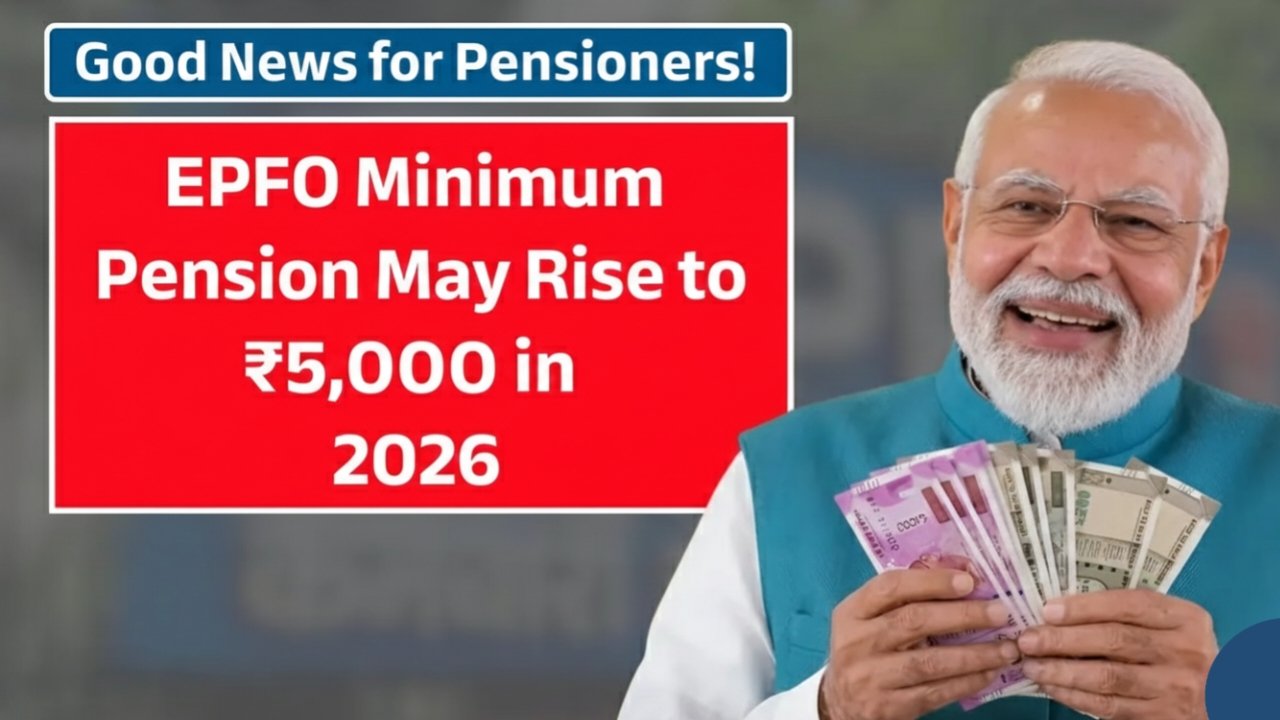
For millions of retired workers across India, the year 2026 could bring long-awaited financial relief. According to ongoing discussions and strong demands from pensioners’ unions, the EPFO minimum pension may be increased to ₹5,000 in 2026. This potential move has sparked fresh hope among EPS-95 pensioners who have been struggling for years with the current minimum pension of just ₹1,000 per month.
Although an official notification has not yet been issued, recent signals from policy discussions and parliamentary debates suggest that pension reform is once again on the government’s priority list. With rising inflation, healthcare costs, and daily living expenses, the demand for a higher minimum pension has become increasingly difficult to ignore.
Current Status of EPFO Minimum Pension
At present, the minimum pension under the Employees’ Pension Scheme (EPS-95) stands at ₹1,000 per month. This amount was last revised in 2014 and has remained unchanged for over a decade. During this period, the cost of living has increased significantly, making it nearly impossible for pensioners to meet basic expenses with such a limited income.
Many retired workers depend entirely on their EPFO pension, especially those from the private sector who do not receive additional retirement benefits. As a result, the gap between pension income and actual living costs has widened year after year.
Why the Demand for ₹5,000 Minimum Pension Is Growing
The demand to raise the EPFO minimum pension to ₹5,000 is not new, but it has gained renewed momentum due to economic realities. Pensioners argue that ₹1,000 no longer reflects the minimum standard of living required for food, rent, medicines, and utilities.
Employee unions and pensioners’ associations have repeatedly highlighted that even government social welfare schemes offer higher monthly support than the current EPS pension. This comparison has strengthened the case for an urgent revision, especially for senior citizens with no other income sources.
Government Discussions and Policy Signals
Over the past few years, several parliamentary committees and labour forums have discussed the issue of EPS pension revision. While no final decision has been announced, government representatives have acknowledged that the matter is under review.
With 2026 approaching and broader pension reforms being considered, policymakers are exploring ways to balance pensioner welfare with financial sustainability. An increase to ₹5,000 is being seen as a practical and humane middle ground, rather than an unrealistic demand.
Who Will Benefit If the Pension Is Increased
If the EPFO minimum pension is raised to ₹5,000, it will benefit over 6 crore EPS-95 pensioners, including retired workers from factories, private companies, and small establishments. Widows, disabled pensioners, and family pension beneficiaries are also expected to receive revised amounts.
For many families, this increase would mean improved access to healthcare, reduced dependence on children, and a more dignified retirement. It would also provide financial stability to households where the pensioner is the primary income source.
Expected Implementation Timeline for 2026
While no official date has been confirmed, experts believe that any pension hike decision may be announced around late 2025 or early 2026. This timeline aligns with broader social security reviews and upcoming budget considerations.
If approved, the revised pension amount could be implemented prospectively, with possible adjustments for existing pensioners. However, expectations of large arrears should be treated cautiously unless explicitly announced by the authorities.
Financial Impact on EPFO and the Government
One of the key challenges in raising the minimum pension is the financial burden it places on the pension fund. Increasing the pension to ₹5,000 would require additional funding support, either through higher government contributions or structural changes within EPFO.
To manage this, the government may consider phased implementation, revised contribution formulas, or partial budgetary support. These measures aim to ensure that pensioners benefit without destabilising the overall pension system.
Comparison with Other Pension Schemes
When compared with other social security schemes, the current EPS pension appears significantly lower. Several state-level welfare pensions already offer monthly benefits ranging from ₹2,000 to ₹3,500, despite not being contributory schemes.
This comparison further strengthens the argument that a contributory scheme like EPS should offer a more realistic minimum pension, especially after decades of service by workers.
What Pensioners Should Do Now
Pensioners are advised to stay informed through official EPFO updates and government announcements rather than relying on unverified online claims. Keeping pension documents updated and ensuring correct bank and Aadhaar linkage will help avoid delays if a revision is announced.
It is also recommended to participate in registered pensioners’ associations, as collective representation has played a major role in bringing this issue to the national spotlight.
Possible Scenarios Ahead
There are three likely outcomes. The first is a direct increase of the minimum pension to ₹5,000. The second is a phased hike starting with a lower amount and gradual increases over time. The third is a revised formula offering higher pensions based on years of service and contributions.
Among these, a phased or formula-based increase is currently seen as the most practical option.
Final Conclusion
The possibility of the EPFO minimum pension rising to ₹5,000 in 2026 represents a significant moment for millions of pensioners across India. While official confirmation is still awaited, the growing policy focus and public pressure suggest that change is likely.
For pensioners, this potential increase is not just about money, but about dignity, security, and peace of mind in their later years. The coming months will be crucial in determining how and when this long-standing demand is finally addressed.