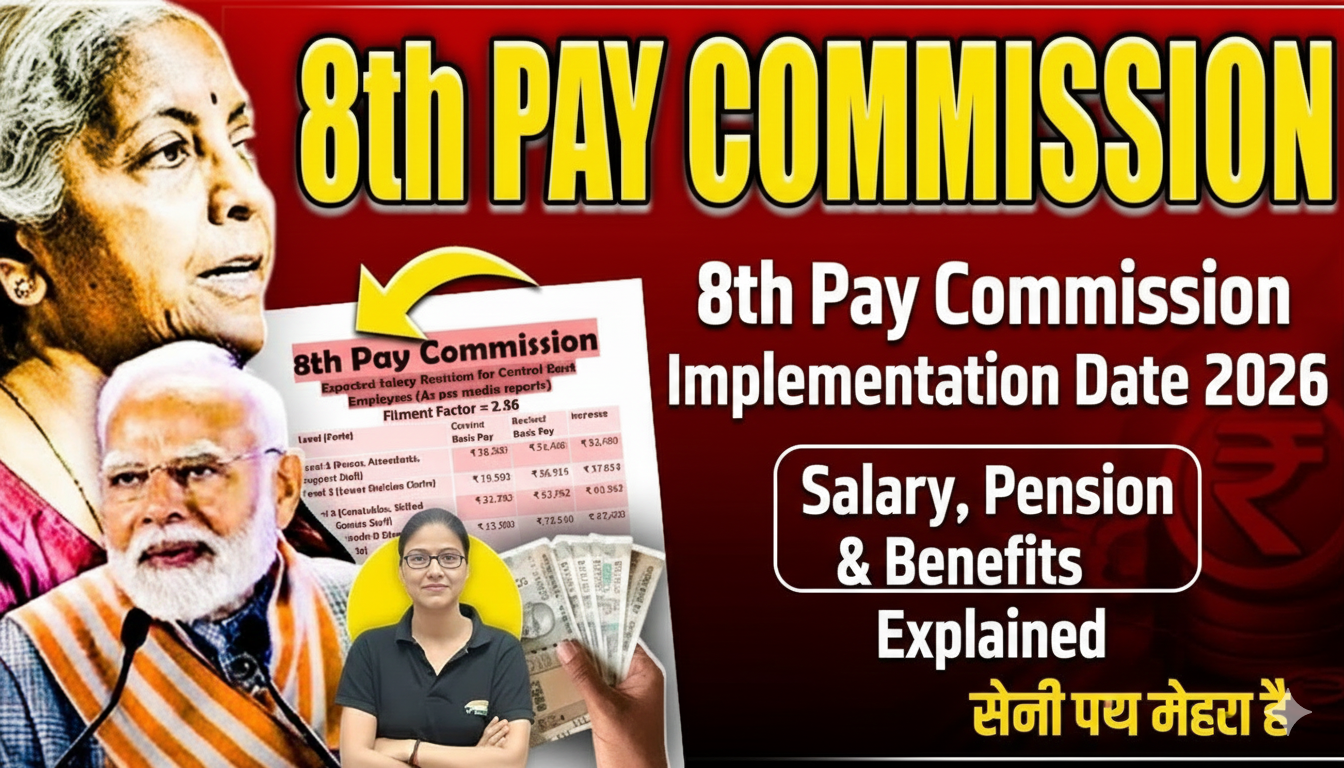
For millions of central government employees and pensioners, the 8th Pay Commission is one of the most closely watched developments in recent years. With salaries under pressure from rising inflation and living costs, expectations are high that the next pay commission will bring meaningful financial relief. As discussions around 2026 grow louder, many people are asking the same questions: when will the 8th Pay Commission be implemented, how much salary will increase, and what will happen to pensions and allowances?
While the government has not yet issued a formal notification, available signals, past patterns, and policy timelines provide a fairly clear picture of what employees can realistically expect.
What Is the 8th Pay Commission and Why It Matters
The Pay Commission is a government-appointed body that reviews and recommends changes in the salary structure of central government employees and pensioners. Its recommendations directly affect basic pay, allowances, pensions, and overall compensation.
The 7th Pay Commission was implemented from 1 January 2016, and traditionally, pay commissions are constituted every ten years. Based on this cycle, the 8th Pay Commission is expected to come into effect from 1 January 2026, even if its recommendations are announced later.
For employees and pensioners, this commission is not just about salary hikes—it shapes long-term financial security, retirement income, and purchasing power.
Expected Implementation Date of the 8th Pay Commission
If historical trends are followed, the effective date of the 8th Pay Commission is likely to be 1 January 2026. However, the formal announcement, report submission, and approval process may extend beyond that date.
In previous pay commissions, the government implemented salary revisions retrospectively. This means employees received arrears for the period between the effective date and the actual implementation date. The same approach is widely expected in 2026.
So even if implementation happens later in the year, the financial benefit is likely to be calculated from January 2026.
How Much Salary Increase Is Expected
One of the biggest questions is the expected salary hike under the 8th Pay Commission. Although no official figures are available, experts estimate a salary increase ranging from 30% to 54%, depending on the fitment factor and final recommendations.
The fitment factor under the 7th Pay Commission was 2.57. For the 8th Pay Commission, discussions suggest it could rise to somewhere between 3.0 and 3.68. A higher fitment factor would directly increase basic pay across all pay levels.
An increase in basic pay has a cascading effect, automatically raising HRA, TA, DA, and other allowances.
Impact on Allowances Like HRA and TA
Allowances form a significant portion of a government employee’s salary. With a higher basic pay under the 8th Pay Commission, allowances such as House Rent Allowance (HRA) and Transport Allowance (TA) are expected to rise substantially.
HRA rates may also be revised based on inflation and urban housing costs. Employees posted in metro cities could see a noticeable increase in take-home salary once the new structure is implemented.
Transport allowance and other location-based benefits are also likely to be recalibrated in line with revised pay levels.
What Pensioners Can Expect in 2026
Pensioners are among the biggest beneficiaries of every pay commission. Under the 8th Pay Commission, pensions are expected to be revised based on the new pay matrix and last drawn salary.
A higher basic pay will lead to a higher basic pension, along with increased Dearness Relief (DR). Family pensioners and those receiving minimum pension benefits could also see improved payouts.
For retirees who are currently dependent on DA hikes to manage rising expenses, a pay commission revision can offer more stable and long-term relief.
DA Merger and Its Possible Role
There is strong speculation that a DA merger may take place before or during the implementation of the 8th Pay Commission. If a large portion of DA is merged into basic pay, it would simplify salary calculations and strengthen the pay base.
Such a move would also help the government design a cleaner and more balanced pay matrix for the new commission. For employees, this would mean better pension calculations and stronger future DA increases.
Benefits Beyond Salary and Pension
The 8th Pay Commission is expected to impact more than just monthly income. Gratuity limits, leave encashment amounts, insurance benefits, and other service-related payments are also likely to be revised.
Employees nearing retirement could particularly benefit, as revised pay and allowances directly influence retirement benefits. Medical allowances and reimbursement limits may also be reviewed to reflect rising healthcare costs.
Government’s Position and Fiscal Considerations
From the government’s perspective, implementing a new pay commission involves a significant financial commitment. Salary and pension expenditure forms a large part of the central budget, so decisions are usually taken after careful evaluation of revenue, economic growth, and fiscal stability.
This is one reason why official confirmation often comes closer to the implementation year. However, once announced, the government has historically honoured pay commission recommendations with retrospective benefits.
What Employees and Pensioners Should Do Now
At this stage, employees and pensioners should stay informed but cautious. Only official government notifications should be trusted, as speculation and exaggerated claims are common around pay commission timelines.
Understanding your current pay level, allowances, and service records will help you better assess the impact once the new structure is announced. Financial planning should be based on confirmed information, not assumptions.
Final Words
The 8th Pay Commission implementation in 2026 is expected to be a major milestone for central government employees and pensioners. While the final details will depend on government decisions, the overall direction points toward meaningful improvements in salary, pension, and benefits.
As inflation pressures continue and expectations rise, the 8th Pay Commission is likely to play a crucial role in restoring income balance and long-term financial security. Until official announcements are made, patience and awareness remain the best approach.